Module 01
Robot Brain / Embodied Intelligence / VLA
World models, action reasoning, VLA-style interfaces, and Real2Sim2Real learning that connect perception with physically grounded robot action.
Industry Application
PIRLab organizes industrial application around three modules: robot brains for embodied intelligence and VLA, industrial autonomous robots for construction automation, and autonomous mobile robots and autonomous driving.
Application Stack
The CV highlights a deployment-oriented agenda: robot world models for engineering automation, infrastructure automation, construction robotics, 3D vision, SLAM, and robot manipulation.
The modules below organize that work by industrial capability: how robot brains reason and act, how autonomous robots operate in construction and infrastructure environments, and how robots perceive and localize in dynamic driving-scale scenes.
Three Modules
Module 01
World models, action reasoning, VLA-style interfaces, and Real2Sim2Real learning that connect perception with physically grounded robot action.
Module 02
Robotic brick laying and autonomous crane operation for construction-site automation and industrial robotic deployment.
Module 03
Localization, mapping, tracking, segmentation, odometry, and scene-flow perception for robots and vehicles operating in dynamic environments.
Module 01
Continual VLA
Continual skill knowledge helps embodied agents acquire new manipulation tasks while retaining earlier capabilities.
Flow world model
Predicted 4D flow gives the robot brain an explicit model of how objects should move under a task instruction.
Vision-Sound-Language-Action
Streaming sound, causal memory, and multimodal reasoning let robots react to acoustic events during execution.
VLA
VLA systems need to accumulate task and skill knowledge across deployments without forgetting earlier behaviours.
World models
4D flow prediction lets robots anticipate scene evolution before committing to contact-rich actions.
Multimodal control
Sound-aware policies extend embodied intelligence beyond static visual evidence and into temporal event understanding.
Module 02
Brick laying robot
The brick-laying robot demonstrates construction manipulation, site-aware motion, and task execution for physical automation workflows.
Autonomous crane
The crane demonstration focuses on autonomous lifting, perception-driven control, and industrial robot coordination in construction environments.
Deployment target
These systems move industrial robotics from structured lab tasks toward site-scale construction processes with heavy equipment and physical materials.
Robot capability
Brick laying and crane operation cover complementary capabilities: precise contact-rich manipulation and large-scale autonomous material handling.
Physical intelligence
3D perception, world modelling, and robot control are combined so construction robots can reason about geometry, tools, materials, and constraints.
Module 03
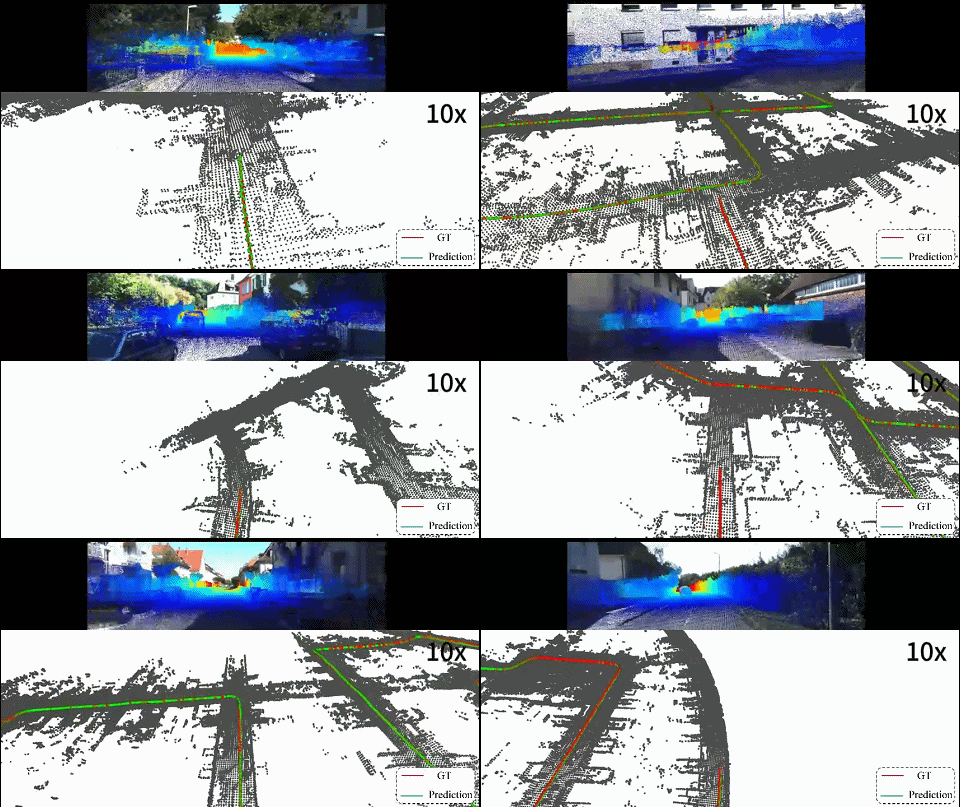
2D-3D localization
Image-LiDAR registration, LiDAR odometry, segmentation, tracking, and scene flow create a robust perception layer for mobile platforms.
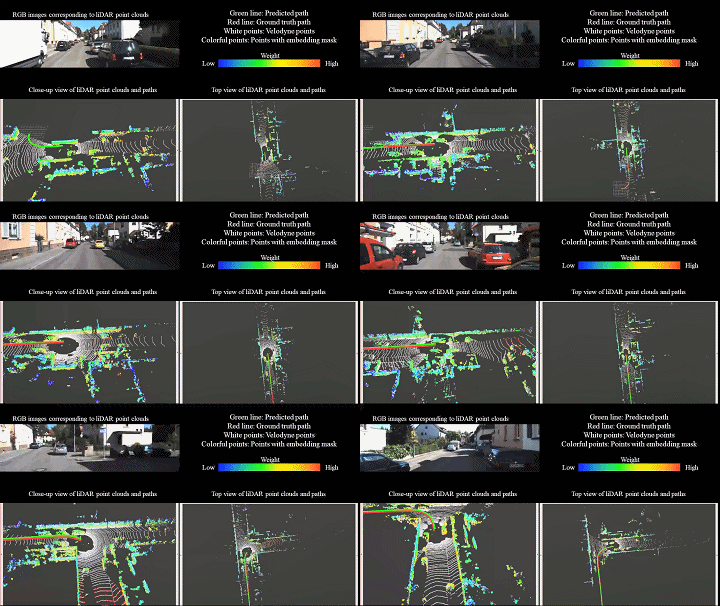
LiDAR odometry
Deep LiDAR odometry and point-cloud registration support reliable state estimation for mobile robots and autonomous driving systems.
Perception stack
2D-3D registration, multi-object tracking, LiDAR odometry, and 3D scene flow form a practical perception stack for dynamic environments.
Road autonomy
Multimodal road data, explicit meshes, and implicit encoding support large-scale road-surface mapping and maintenance-oriented analysis.
Robust deployment
Segmentation, occupancy refinement, and motion prediction help robots reason about moving objects and changing road environments.